


Of everything happening across the markets right now, if I had to name one thing I’m personally watching most closely, it would be what SpaceX insiders do over the next few months. I’ve become a little more cautious after digging into this. It’s not because I think the AI buildout is fake or that SpaceX is a bad company. I just think SpaceX could give us a useful look at how insiders respond when excitement and valuations are both extremely high.
SpaceX’s Rocky Start
SpaceX completed the largest IPO in history with more hype behind it than almost any listing I can remember. After initially surging, the stock is now down nearly 25% since joining the Nasdaq 100 and has fallen below its $135 IPO price.
That isn’t completely out of line with how other recent major IPOs have traded, but I still think it’s worth watching. It could be a sign that expectations simply got ahead of the business.
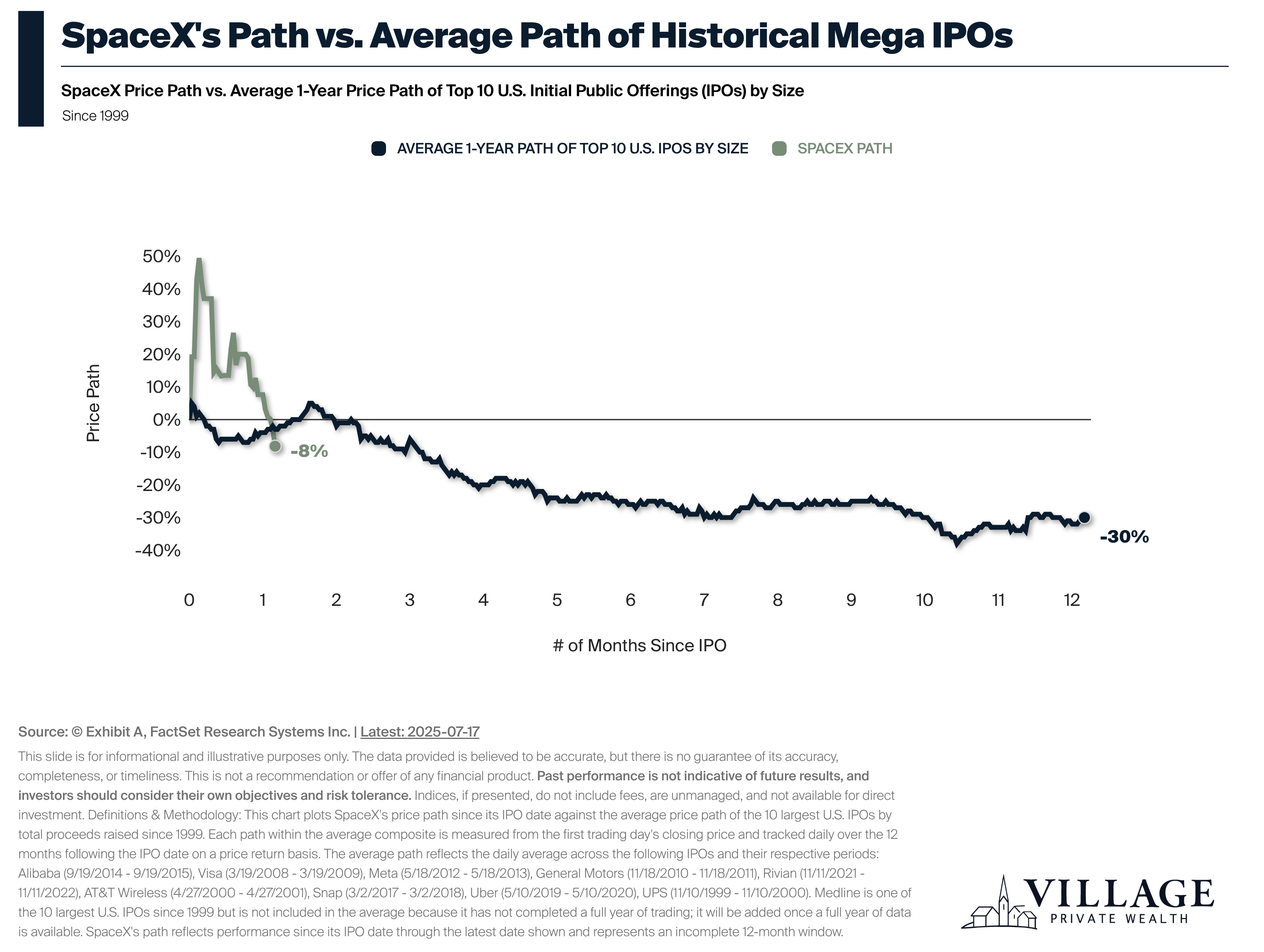
The decline could be tied to several things, including SpaceX’s valuation, its lack of consistent profitability, recent operational setbacks, and the additional shares that could enter the market once insider lockups begin to expire.
Companies are naturally more likely to go public when investor demand is strong and valuations are attractive. That doesn’t mean insiders know a downturn is coming, but the timing is still worth paying attention to. When markets are strong, companies rush to go public and raise money. When markets turn south, IPOs tend to disappear.
A Familiar Example From 2007
Blackstone went public in June 2007 when the market was booming. It was one of the largest United States IPOs since the dot com bubble and raised $4.13 billion.
Co founders Stephen Schwarzman and Peter Peterson reportedly cashed out roughly $2.6 billion combined in connection with the offering. About a year later, the Global Financial Crisis hit, the stock market crashed, and Blackstone shares eventually fell nearly 90% below their IPO price.
That doesn’t mean Blackstone’s founders knew a crisis was coming. They may have simply gotten lucky with the timing. One example also isn’t enough to establish a reliable pattern (although there are plenty more). Still, it shows why I think large liquidity events during periods of extreme optimism are worth paying attention to.
More AI IPOs Could Be Coming
Now we have two major AI companies, OpenAI and Anthropic, taking steps that could eventually lead to their own IPOs.
Both have confidentially filed paperwork with the SEC. Anthropic filed first, followed by OpenAI about a week later. Anthropic was recently valued near $965 billion in the private market, while reports suggest OpenAI could eventually seek a valuation approaching $1 trillion.
A confidential filing doesn’t guarantee either company will go public soon. It simply gives them the option. Still, I think it raises a fair question. Are these companies just preparing for the future, or do they believe the current market gives them an unusually good opportunity to raise capital?
Based on its price to sales ratio, SpaceX is currently valued higher than every company in the S&P 500, even though it isn’t consistently profitable. That kind of gap usually closes in one of two ways. Either the business grows into the valuation over the next several years, or the stock price comes down to meet the business.
SpaceX’s second quarter earnings report in early August should give investors their first major update since the company went public.
The Signal I’m Watching
What SpaceX insiders do next could tell us a lot more. Unlike most IPOs, we have specific dates to watch instead of just a vague feeling that something might be off.
Most IPOs release insider shares on one date, usually around 180 days after the company goes public. SpaceX structured its lockup differently by spreading the releases over several months.
The first meaningful group of shares, roughly 20% of the locked shares, is expected to unlock around the company’s first earnings report in early to mid August. More shares become available through September, another larger release comes around the third quarter earnings report, and the full 180 day lockup clears in December. Elon Musk’s shares, which make up the company’s largest individual holding, remain locked until June 2027.
It’s important to remember that an unlock doesn’t mean all those shares will immediately be sold. It only means those shareholders are allowed to sell.
That’s why I’m treating this as something to watch rather than a reason to panic. If early employees and investors hold their shares through the August and September windows, it could show that the people closest to the company still believe in its long term value.
If we see heavy selling, that would be worth paying attention to. It still wouldn’t prove that insiders expect the stock or the broader market to fall. Employees and early investors might sell to diversify, pay taxes, or finally create some liquidity after having so much of their wealth tied to one company for years.
I’m not saying any of this proves a broader market decline is coming. SpaceX’s unusual lockup schedule simply gives us several opportunities to see how the people closest to the company respond to its current valuation.
If insiders mostly hold, that could be a sign of continued confidence. If they sell heavily, it could be a sign that the excitement got ahead of the business.
Either way, I’ll be watching it closely, especially with OpenAI and Anthropic potentially following SpaceX into the public markets.