


If you have heard people say the AI boom is mostly hype, this chart is worth a long look.
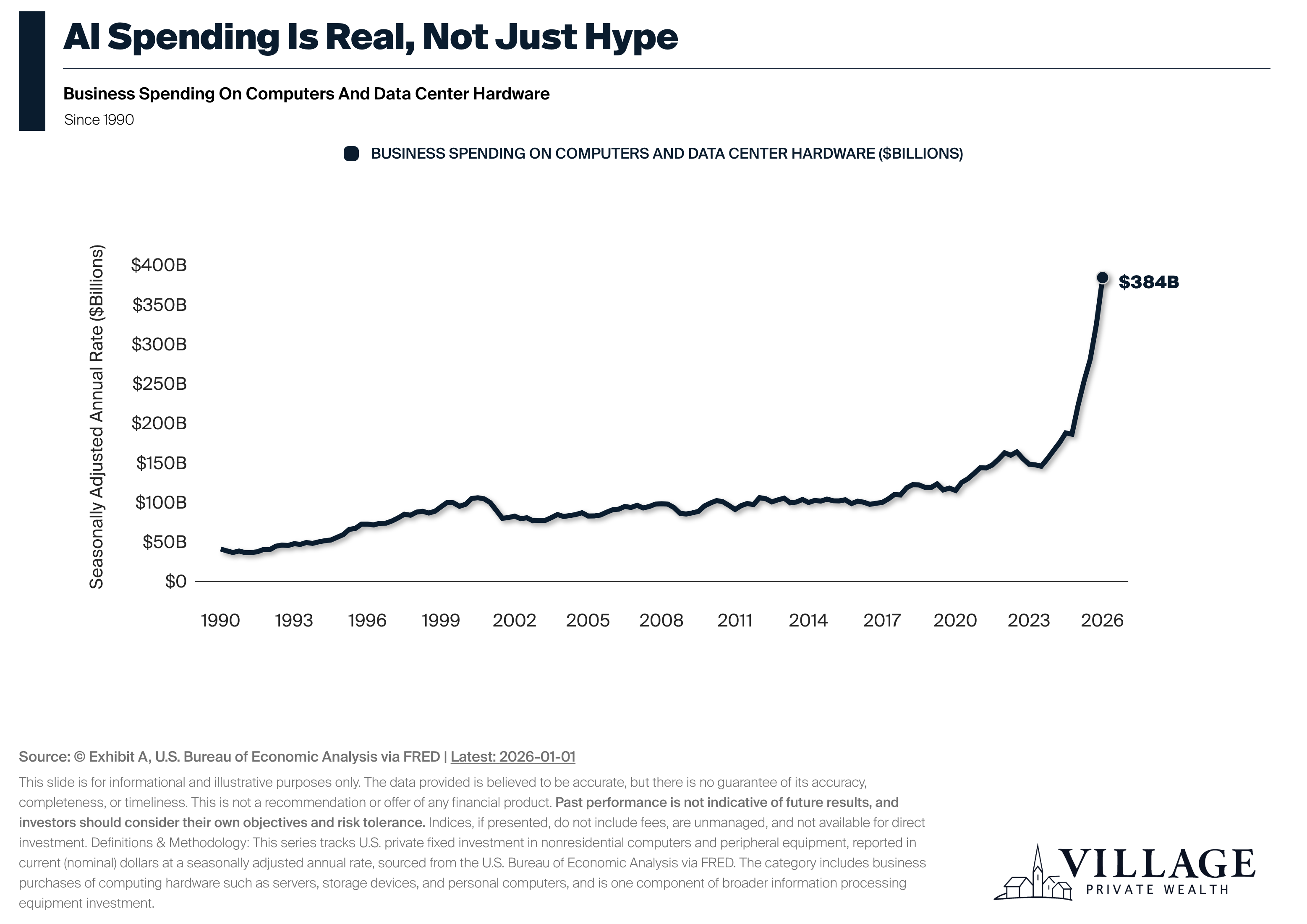
It tracks what U.S. businesses spend on computers and data center hardware going back to 1990. For most of that stretch the line drifts along gradually. Then over the last couple of years it goes nearly vertical, reaching a seasonally adjusted annual rate of $384 billion as of January 2026 (U.S. Bureau of Economic Analysis via FRED).
That is not a forecast or a headline. It is actual money already spent on servers, storage, and chips, showing up in hard economic data.
The spending is not in doubt
We all know the technology is moving fast. ChatGPT, Claude, and Gemini get noticeably better every few months. What this chart adds is proof that the money behind it is real and enormous.
The companies building this are not shy about it. For 2026, the four largest cloud players are guiding to roughly $700 to $725 billion in combined capital spending, up about 77 percent from around $410 billion in 2025. The rough breakdown:
- Amazon: about $200 billion
- Microsoft: about $190 billion
- Google: $175 to $185 billion
- Meta: $115 to $135 billion
Analysts already expect that combined number to top $1 trillion in 2027.
So the spending question is settled. The more interesting question is different.
The real question: does it turn into earnings?
This is the part I keep coming back to. You cannot pour hundreds of billions into infrastructure forever and have nothing to show for it on the income statement. At some point capex has to translate into revenue and profit, or the story falls apart.
Right now the evidence is mixed, which is exactly why it is worth watching.
Where the earnings are clearly showing up
Some of this is already paying off in obvious ways:
- Nvidia is the cleanest example. It sells the chips everyone else is buying. For its fiscal 2026 year it reported $215.9 billion in revenue, up 65 percent, and roughly $120 billion in net income, at gross margins near 75 percent. Its most recent quarter grew 85 percent over the prior year. The picks and shovels business is unambiguously profitable.
- Google Cloud revenue grew 63 percent in its most recent quarter to about $20 billion, with a reported order backlog over $460 billion.
- Microsoft says its AI business has passed a $37 billion annual run rate.
Bulls point to this and argue the return is already visible through accelerating cloud growth and a very large backlog of signed work.
Where the risk sits
The bear case is not really about whether AI works. It is about timing and math:
- Free cash flow takes a hit. When you spend this much, the cash that used to flow to shareholders gets redirected into buildings and chips. Amazon's free cash flow is projected to turn negative this year.
- Depreciation is a real headwind. These are expensive assets that wear out. Some chips may have a useful life of only a few years while being depreciated over five or six, which can pressure future earnings.
- Spending relative to sales is at historic highs. For several of these firms, 2026 capex is running close to half of revenue, a level that cannot continue indefinitely.
- More of it is funded with debt. Recent examples include Amazon raising tens of billions in bonds and Alphabet issuing an unusually long century bond.
The cautionary tale people keep citing is Oracle, which lost roughly $80 billion in market value in a single session late last year when investors did the math on its buildout and the debt behind it.
The bottom line
The chart tells us the spending is real. It does not tell us whether the spending will be worth it.
My take is that the next year or two is the proving ground. The companies doing the spending are highly profitable and generate enormous cash, which is very different from the unprofitable startups of the dot com era. But that does not make them immune. The market will eventually demand to see this capex show up as durable earnings, not just bigger data centers.
So when you watch these companies report, I would pay less attention to how much they are spending, which we already know is a lot, and more to a simpler question: is it actually making them more money?
That is the number that ends the hype debate for good.