


Every day I see at least one headline wondering if we're in a bubble. Everyone keeps comparing today to the dotcom bubble back in 2000, which is exactly why I'm confused it's still in question. Whatever you want to call the broader AI trade, one thing is clear: Nvidia itself isn't priced like a bubble. The company is earning real money, and the market is pricing it that way.
Take a look at this chart:
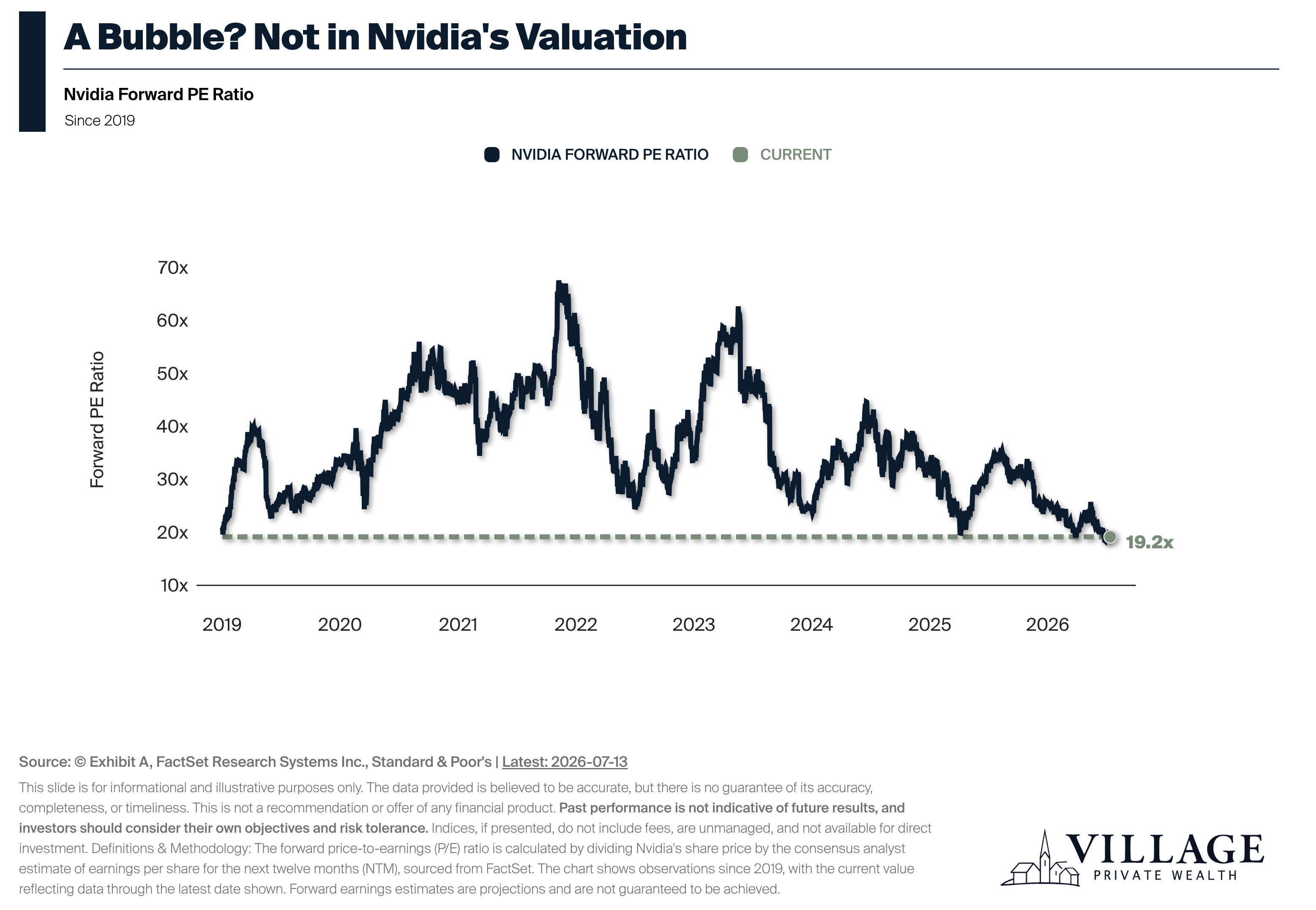
This chart tracks Nvidia's forward price-to-earnings ratio since 2019, which compares the company's share price to expected earnings over the next twelve months. It shows how the market's valuation of Nvidia has changed over time as earnings expectations have evolved.
Nvidia's forward P/E currently sits at 19.2x, near the lowest level of the entire period shown and well below its peak of roughly 65x in late 2021. While the stock price has risen in recent years, earnings estimates have grown even faster, steadily compressing the multiple.
Nvidia, one of, if not the, fastest growing companies because of AI, is earning real money, and its valuation is actually low compared to where it's been. That multiple is only as good as the earnings estimates behind it, and those estimates have kept climbing right alongside the stock, which is exactly why the P/E has come down instead of up.
The Dotcom Comparison: Cisco
To see the difference, look at Cisco. At its March 2000 peak, Cisco's forward P/E hit roughly 131x. Cisco briefly became the world's most valuable company, with shares up 236% from the start of 1999 to March 2000, reaching a market cap of $555 billion. The stock then collapsed 80% over the next two years.
Cisco's problem was a huge P (price) without nearly enough E (earnings), and its telecom customers had overbuilt network capacity that demand couldn't fill. Nvidia's setup looks different: plenty of earnings, a reasonable price, and demand for AI chips that so far keeps showing up in the numbers.
The Bottom Line
The economy has seen a bubble before, so we're very aware of what one looks like. If Nvidia's P/E was still sitting north of 60x, I'd be worried. It's not. At 19.2x, near the low end of its own five-year range, the market's pricing of its most important AI company looks anything but bubbly.